
The business world loves acronyms these days, so let me introduce one I’ve found to be of profound import for any business selling to other businesses: Time To Success.
Conceptually, it’s a simple thing: the number of weeks or months between first contact for a new customer or application and the point where the customer receives delivery of its first volume order.
For the supplier, there are stark benefits to cash-flow in reducing TTS, yet it’s rarely if ever measured and hasn’t had a name. That needs fixing.
Consider the case of a new application opportunity. There are three basic building-blocks in the sequence:
-
The engagement:
- The customer responds to messaging and reaches out. This is t=0.
- The sales-and-applications team engages,
- The potential is evaluated and resources are marshaled,
- The customer is convinced and places an evaluation order.
-
The implementation loop:
- The customer receives their first order,
- The customer implements the solution,
- Questions are raised,
- Support is provided,
- Issues are identified and resolved,
- (loop)
- The customer is happy.
-
The consummation:
- A production order is procured,
- Volume deliveries commence and grow. This is t=TTS.
This sequence is the daily stress-test for any B2B supplier. Each step is an inflection point for future cash flow. Hence: Each step represents a sales function, no matter how far from the bullpen those responsible might be at any moment. Lesson: We are all sales people. You’re a manager? No, you’re a salesman. You’re in manufacturing, service, documentation, perhaps a luminary on Mahogany Row? No: You, yes you, are driving cashflow. Or impeding it. You’re sales, because you influence TTS.
Let’s take a look the impact of TTS on cashflow. Consider a simple spreadsheet model starting with the evaluation order of one unit (at an example price of $50,000, though that doesn’t matter), delivery from stock, 30 days net terms. Assume good growth of 20%, commencing 6 months after the initial volume order.
Straightforward, understandable, admittedly simplistic. But illuminating:
The timeline is dominated by the long desert months of customer development, including the time it takes the customer to receive and pay for the product, figure it out, generate the necessary software, debug and test everything, fix stuff and start again, and so on. This is the loop in the sequence. It includes both parties confronting and resolving issues ranging from documentation shortfalls to repairs.
Consider two scenarios: TTS=18 months and TTS=9 months:
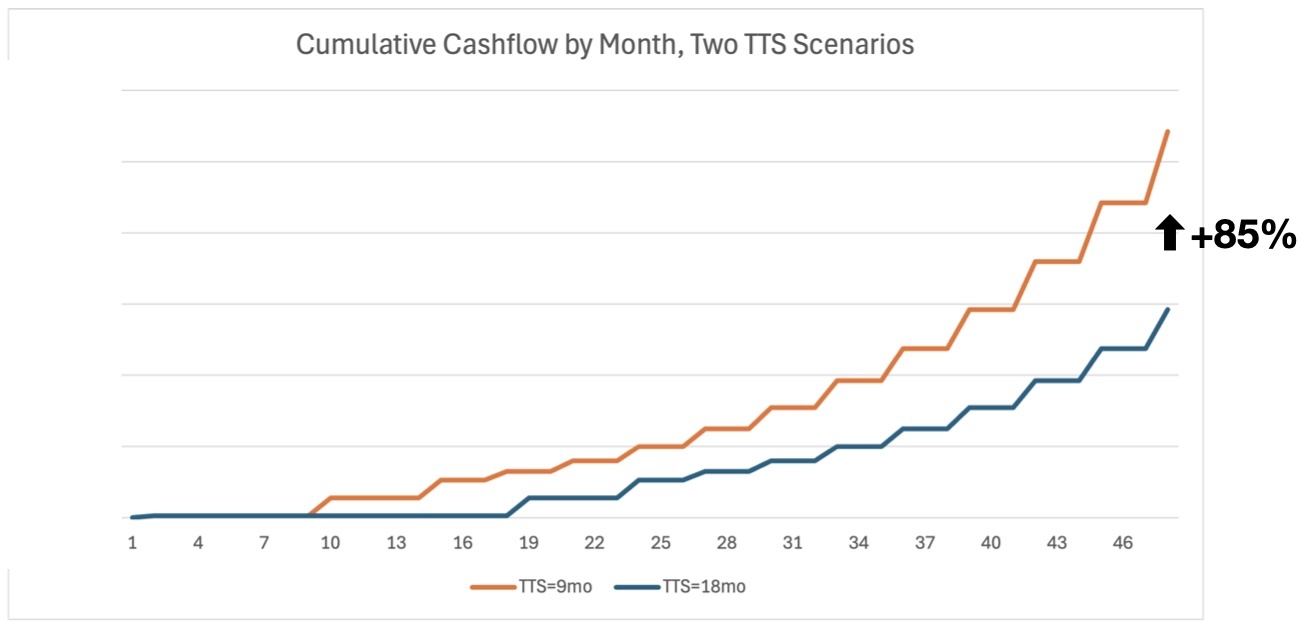
The timelines are primarily impacted by that loop. Any delivery delays beyond that ship-from-stock assumption obviously contribute, but I made that assumption to spotlight the loop: lead-times are readily measured, but that loop is too often overlooked.
Now, cutting TTS in half is quite the challenge, but my point is that we should try. As this model demonstrates, cutting TTS in half means 4-year cumulative cash flow improves by 85%! And that’s without R&D, without capital investment, without costly marketing campaigns, without risky new-market salients… just with everyone doing their job in a manner that prioritizes and minimizes the customer’s time to success.
If a 85% cashflow increase sounds good to you, note how it starts with measuring TTS (a simple matter indeed: date of first outreach to date of volume P.O.) and addressing each contributor in the sequence.
This leads to some un-obvious questions spotlighting topics often brushed aside as necessary evils, too puerile for management or engineering attention:
- How good is your documentation? Does it (or a tech note, article or example) show how to succeed in this application? Or does it toss all functionality into one pot and expect the customer to pick through it?
- How helpful is your software? Is your command-set comprehensible, well-thought-out, readable? is your implementation platform-independent, safe, and ready for an increasingly autonomous world?
- How data-based and transparent are your specs? Do you discuss issues that might impede a customer dependent on them? Or is there an assumption that everyone receiving your product is as expert in mounting, cabling, provisioning and using it as your engineers are?
- How effective is your support? Does your staff prioritize helping customers up the learning curve, or is this left as a character-building exercise for the user? Or, worse, is enabling support provided only for a fee? Does your team “speak the language” of the application so the customer can view them as partners?
- Would it accelerate the sequence (and increase cash flow) to offer special terms, discounts or a loaner for that first evaluation order? Or do you think you’re minimizing risk by putting obstacles up-front?
- What happens when things inevitably go wrong? Are repairs handled expeditiously? Better, are repairs prevented by connection and clear communications?
Any time the customer spends waiting…
…any time they are disincentivized from engaging…
…any time spent in that loop…
…increases TTS, reduces your cashflow, delays opportunity, and opens the door for your competition.
Ideally, your leadership will have the tools and insights needed to track and minimize TTS, including evaluating resource allocations so big opportunities yield big cashflow in a hurry.
Sometimes it helps to have external eyes do a deep dive to identify opportunities for improvement. That’s what Aikidovation™ is for. Give us a ring.